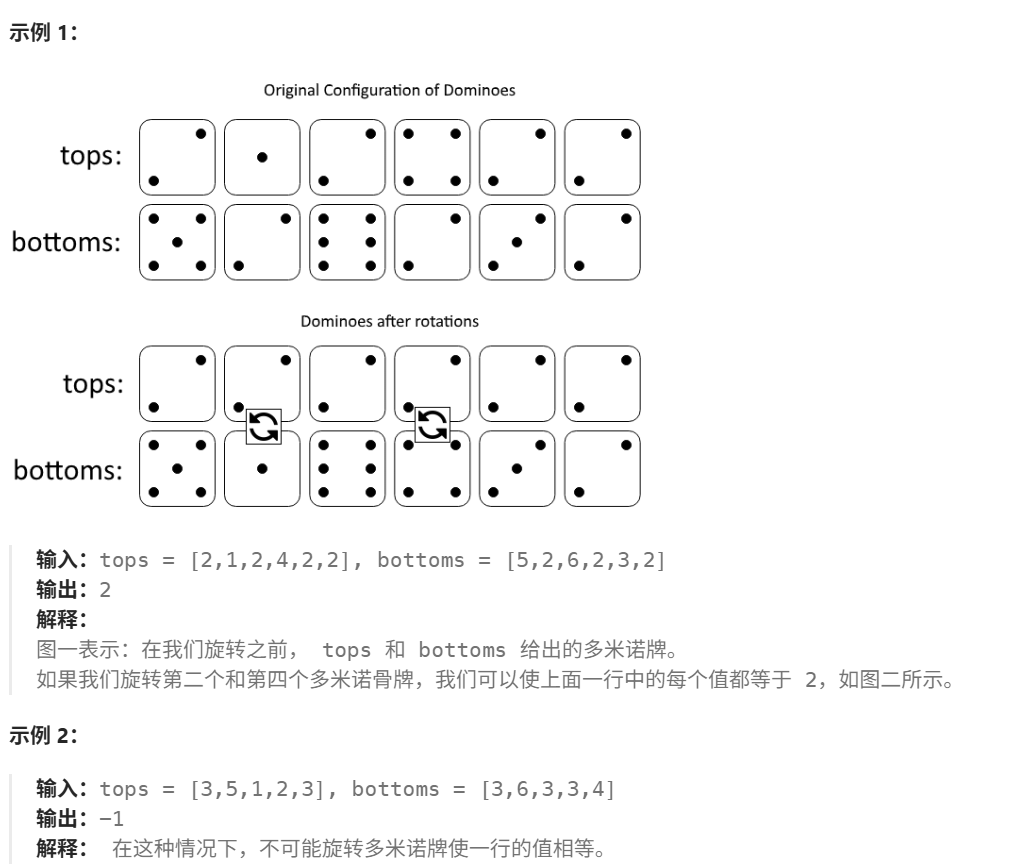
题目描述 1007.Minimum Domino Rotations For Equal Row
给定两个数组 tops 和 bottoms,表示一排多米诺骨牌的上下半部分。目标是通过旋转多米诺骨牌,使得 tops 或者 bottoms 中所有的数字相同。目标是最小化所需的旋转次数
样例 以下是一个输入输出的示例:
Tips:
解题思路 初读题目时,我的第一反应是暴力解法,尝试交换每一个 top[i] 与 bottom[i],但是这种方法的时间复杂度是
考虑到题目中给定了数字范围 tops 或 bottoms 在交换后整行都一致。具体来说,我们需要找出数字 num,使得对于每个 i,都满足 tops[i] == num || bottoms[i] == num。
这一步可以通过一次遍历来实现,同时可以将其优化为
最初,我考虑使用 集合(set) 来解决问题,但代码实现过于复杂。最终,我选择了 DP 来筛选候选数字。
筛选候选数字 设定 f[i][j] 表示依次检查到bottoms[i] 与 tops[i] 时, 数字j 能否使 tops 和 bottoms 数组在交换后变得一致。tops[i] 或 bottoms[i] 不等于当前数字
1
2
3
4
5
6
7
8
9
10
11
12
13
14
15
16
17
18
19
int n = tops.size ();vector<bool > f (7 , true ) ;for (int i = 0 ; i < n ; i++) { int t = tops[i]; int b = bottoms[i]; for (int j = 1 ; j <= 6 ; j++) { if (j == t || j == b) f[j] = f[j] && true ; else f[j] = false ; } }
计算最小旋转次数 然后,使用筛选出的数字来计算最小的旋转次数
1 2 3 4 5 6 7 8 9 10 11 12 13 14 15 16 17 18 19 stack<int > st; for (int i = 1 ; i <= 6 ; i++) { if (f[i]) st.push (i); } if (st.empty ()) return -1 ; int res = INT_MAX;while (!st.empty ()) { int target = st.top (); st.pop (); int cnt_top = 0 , cnt_bottom = 0 ; for (int i = 0 ; i < n; i++) { if (tops[i] == target) cnt_top++; if (bottoms[i] == target) cnt_bottom++; } res = min (res, n - max (cnt_top, cnt_bottom)); }
在这部分代码中,我们从所有可能的候选数字(存储在栈 st 中)中,计算出每个数字变为目标数字所需的最小旋转次数。
完整代码实现 1 2 3 4 5 6 7 8 9 10 11 12 13 14 15 16 17 18 19 20 21 22 23 24 25 26 27 28 29 30 31 32 33 34 35 36 37 38 39 40 41 42 43 class Solution {public : int minDominoRotations (vector<int >& tops, vector<int >& bottoms) int n = tops.size (); vector<bool > f (7 , true ) ; for (int i = 0 ; i < n ; i++) { int t = tops[i]; int b = bottoms[i]; for (int j = 1 ; j <= 6 ; j++) { if (j != t && j != b) f[j] = false ; } } int cnt = 0 ; stack<int > st; for (int i = 1 ; i <= 6 ; i++) { if (!f[i]) cnt++; else st.push (i); } if (cnt == 6 ) return -1 ; int res = INT_MAX; while (!st.empty ()) { int target = st.top (); st.pop (); int cnt_top = 0 ; int cnt_bottom = 0 ; for (int i = 0 ; i < n; i++) { if (tops[i] == target) cnt_top++; if (bottoms[i] == target) cnt_bottom++; } res = min (res, n - max (cnt_top , cnt_bottom)); } return res; } };
总结反思
冗余操作 :
f[j] = f[j] && true 语句是冗余的,可以直接简化为 f[j] = true。使用栈 st 存储候选数字并不必要,直接遍历 f 数组即可。
中间变量不必要 :
变量 cnt 用来判断无交集的情况并没有实际用处,可以直接在计算过程中处理。
化简为繁
其实没有必要筛选必要的数字,因为数字只可能从tops[0] 与 bottoms[0] 中产生。所以要么都变成 tops[0],要么都变成 bottoms[0]。计算这两种情况,取最小值。
最后附上灵茶山艾府的代码与题解
1
2
3
4
5
6
7
8
9
10
11
12
13
14
15
16
17
18
19
20
21
22
23
class Solution {public : int minDominoRotations (vector<int >& tops, vector<int >& bottoms) auto min_rot = [&](int target) -> int { int to_top = 0 , to_bottom = 0 ; for (int i = 0 ; i < tops.size (); i++) { int x = tops[i], y = bottoms[i]; if (x != target && y != target) { return INT_MAX; } if (x != target) { to_top++; } else if (y != target) { to_bottom++; } } return min (to_top, to_bottom); }; int ans = min (min_rot (tops[0 ]), min_rot (bottoms[0 ])); return ans == INT_MAX ? -1 : ans; } };